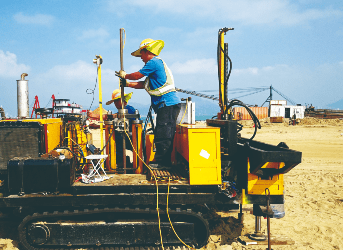
The Hong Kong-Zhuhai-Macau Bridge, a landmark infrastructure project in China, spans 55 kilometers, connecting Hong Kong, Macau, and Zhuhai across the Lingdingyang waters of the South China Sea. The project starts at the artificial island of Hong Kong Port near the Hong Kong International Airport, crosses the main bridge of 29.6 kilometers, and extends 41.6 kilometers from Hong Kong Port to the Zhuhai Macau Port. The bridge, designed as a two-way six-lane expressway with a speed limit of 100 km/h, required an investment of 126.9 billion yuan.
The bridge is internationally recognized for its massive construction scale, unprecedented engineering challenges, and advanced construction technologies. A core component of the project is the Hong Kong Port, which includes a reclaimed artificial island covering 1.4968 million square meters northeast of the Hong Kong Airport.

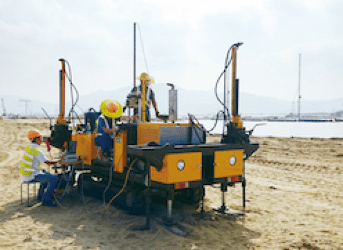
Our company was responsible for the engineering survey work for this project, with the goal of accurately defining soil layer characteristics within the artificial island range. The survey focused on identifying soil types, soil consolidation coefficients, permeability coefficients, dynamic parameters, and structural parameters. These findings provided a critical basis for analyzing soil loading and consolidation parameters following the reclamation process.
The survey was conducted between September 2014 and May 2016, utilizing the hole pressure static penetration test (CPTU) detection system, developed by Geomil in the Netherlands. The survey covered depths of 30–50 meters, analyzing data from approximately 1,000 boreholes. The CPTU, introduced in the 1980s, is a cutting-edge technique in geotechnical engineering and is particularly effective for soft soil investigations. Its widespread use in developed countries has significantly advanced the field of soft soil engineering, contributing to the successful execution of this complex project.
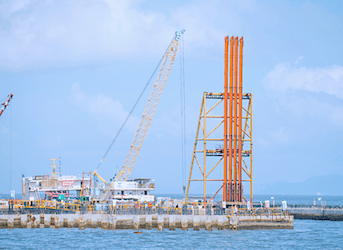
The construction of comprehensive waste management facilities in Hong Kong aims to significantly reduce mixed urban solid waste volumes while recycling valuable resources. The project will be developed in phases, with the first phase involving the creation of an artificial island spanning 16 hectares near Shiguzhou. This island will house urban solid waste incineration and power generation facilities, capable of processing 3,000 tons of mixed solid waste daily and generating approximately 480 million kilowatt-hours of electricity annually, sufficient to supply 100,000 households. Full operations are expected to commence by 2025.
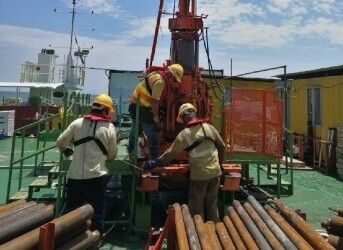
The offshore survey for this project comprises two key components: CPTU static cone penetration testing and core testing, which involve drilling 3 meters below the weathered rock layer. Core testing further includes drilling core sampling, standard penetration tests (SPT), vane shear tests (VST), and drilling water injection tests.
Our company is responsible for executing the survey work using the CPTU pore pressure static penetration testing system, specifically the Manta-200 system produced by Geomil in the Netherlands. This advanced system is well-suited for nearshore environments with water depths of less than 500 meters and is typically deployed on barges or offshore platforms. It enables highly accurate assessments of soil conditions in offshore seabeds, providing critical data for the project’s foundation engineering.
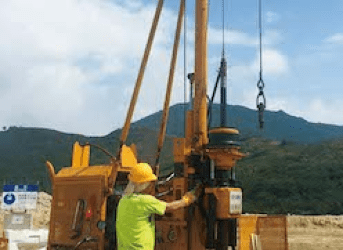
The 137th landfill area in Tseung Kwan O spans approximately 104 hectares and consists of a mixture of inert materials such as soil, stone, crushed concrete, and waste generated from various construction activities in Hong Kong.
Our company is responsible for conducting the survey work for this project, which includes CPTU static penetration tests, in-situ cross plate shear tests, drilling core sampling, and other investigative operations. The maximum drilling depth for the survey operations reaches 70 meters, ensuring comprehensive analysis for project requirements.
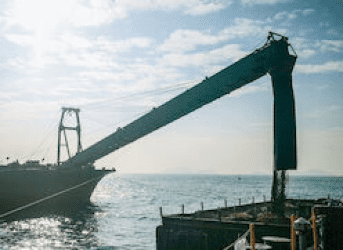
The construction of comprehensive waste management facilities in Hong Kong aims to significantly reduce the volume of mixed urban solid waste while recycling valuable resources. The project will be implemented in stages, with the first phase involving the creation of a 16-hectare artificial island near Shiguzhou. This island will house urban solid waste incineration and power generation facilities, capable of processing 3,000 tons of mixed solid waste daily and producing 480 million kilowatt-hours of electricity annually, enough to supply 100,000 households. The facilities are expected to be fully operational by 2025.
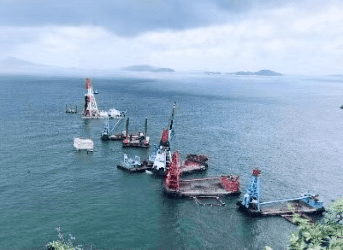
The project scope includes laying a sand cushion layer on the seabed surface of the embankment and the lower part of the seawall, with a thickness of 2 meters. Our company is responsible for executing this construction work, which involves approximately 200,000 cubic meters of sand laying over a 5-month construction period.


